

D365 SCM 10.0.48: Flexibly Manage the Product Lifecycle
Manage Product Lifecycle States in Dynamics 365 Supply Chain Management 10.0.48
With Dynamics 365 Supply Chain Management 10.0.48, Microsoft extends the use of product lifecycle states for released products and released product variants outside of Engineering Change Management. Product lifecycle states therefore do more than simply describe a phase such as Prototype, Active, Obsolete, or End-of-life. They can also serve as business-level guardrails by determining the business processes in which a product may continue to be used.
This enhancement is particularly relevant for organizations that want to manage standard products throughout their entire lifecycle with greater transparency and control, without implementing a complete Engineering Change Management solution. The focus is on establishing a clear and understandable connection between the product status, its operational use, and its relevance to planning.
System Requirements
The following basic system requirements must be met to use this functionality:
- Microsoft Dynamics 365 Supply Chain Management version 10.0.48 or later is installed.
- The Configure Product Lifecycle State business process policies without Engineering change management feature is enabled in Feature management.
- The required permissions are available for Product information management, the maintenance of product lifecycle states, and their assignment to released products.
From Product Status to Operational Process Control
In many organizations, a product status indicates whether an item is active, being phased out, or has already been discontinued. However, this information alone is often not sufficient for day-to-day operations. What matters is how the status affects procurement, sales, production, planning, and forecasting.
Product lifecycle states therefore connect the business classification of a product with its operational use. The status not only indicates the phase of the product lifecycle but can also establish clear guardrails for the business processes in which the product may be used. In this way, the lifecycle state becomes an active control mechanism within product management.
The functionality is particularly useful in scenarios where products are introduced in a controlled manner, used in regular operations, gradually phased out, or permanently discontinued. Instead of relying exclusively on work instructions, separate lists, or manual coordination to enforce these decisions, the relevant rules can be defined directly in relation to the product lifecycle state.
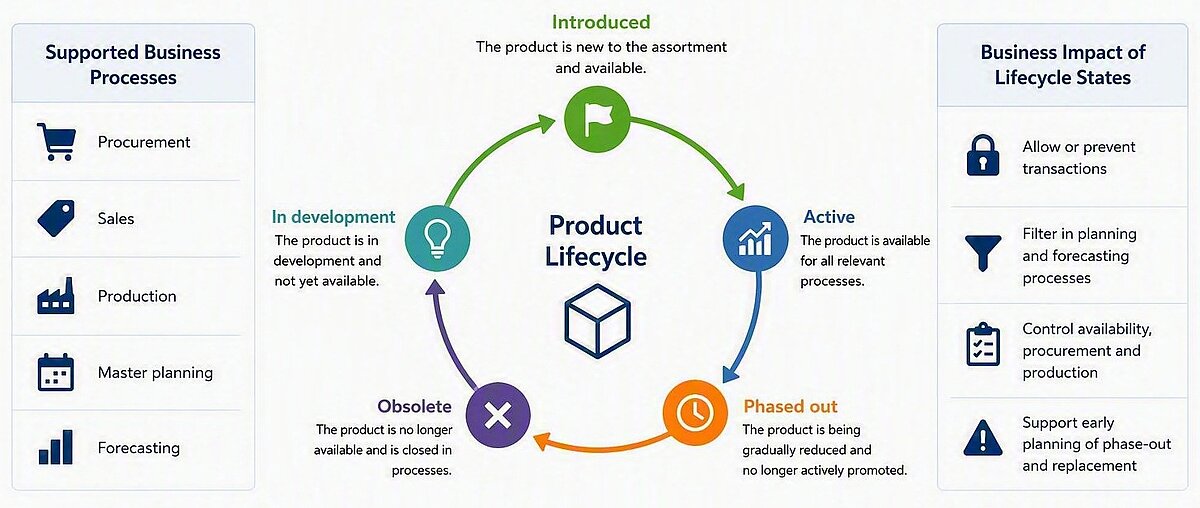
Which Business Areas Are Supported?
Product lifecycle states can affect several key processes in Dynamics 365 Supply Chain Management:
- Procurement: Provides guidance on whether a product is still intended for use in new procurement transactions.
- Sales: Provides clarity on whether a product should continue to be offered and used in new sales transactions.
- Production: Determines whether a product remains relevant for production-related processes.
- Planning: Controls whether a product is included in master planning and in calculations at the bill of materials (BOM) level.
- Forecasting: Takes the product lifecycle state into account when determining whether the product is intended for use in forecasting processes.
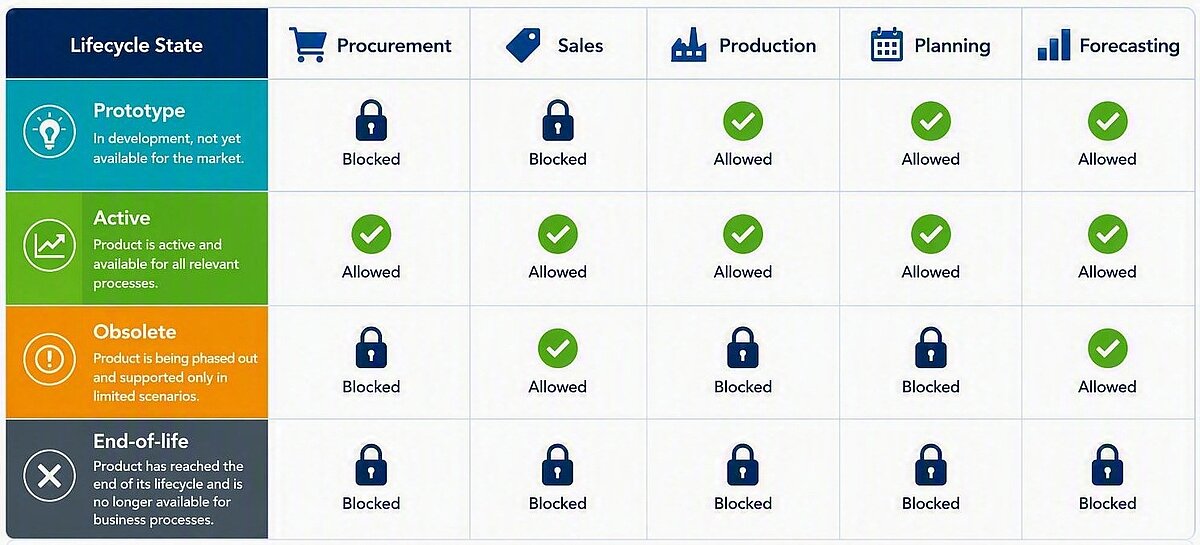
The business processes that are permitted or restricted depend on the respective product lifecycle state and the organization’s target operating model. The following illustration provides an example of how business processes can be allowed or blocked depending on the lifecycle state. It does not represent a universally applicable standard configuration.
More Targeted Control over Planning Relevance
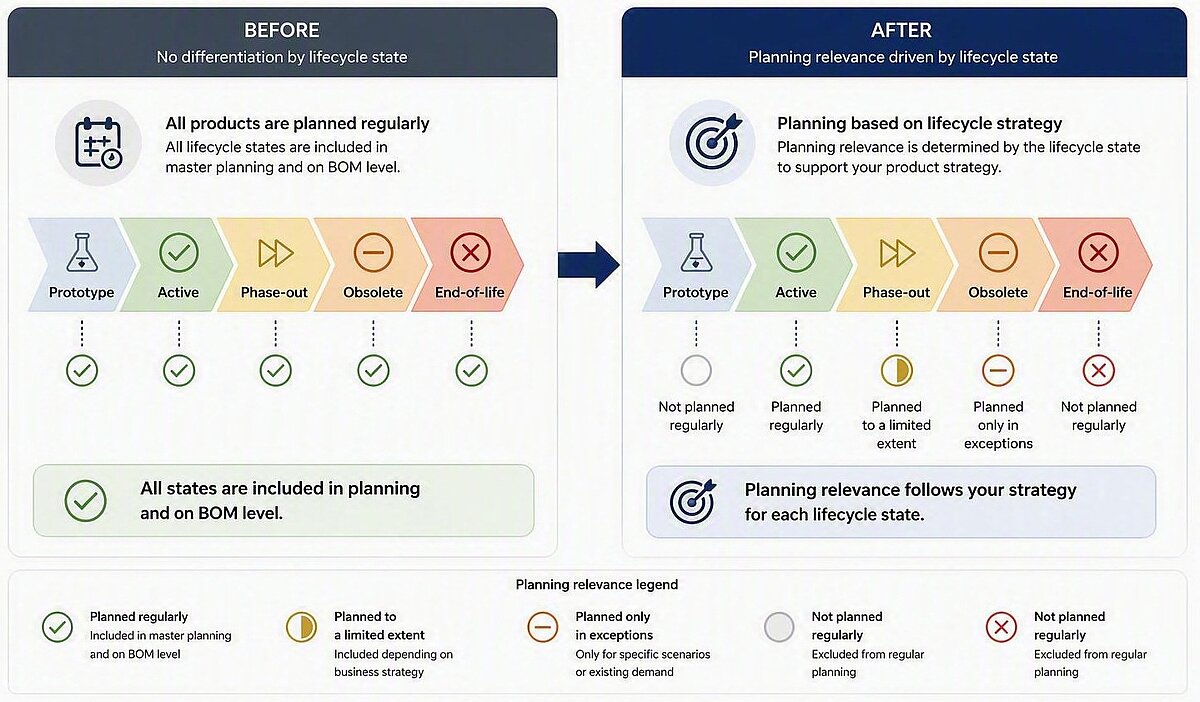
An important aspect of this functionality is its integration with master planning. The planning relevance of a product lifecycle state determines whether products assigned to that state continue to be included in planning calculations and calculations at the bill of materials (BOM) level. This allows planning to be aligned more closely with the actual product strategy.
This distinction is particularly relevant for products that are being phased out or permanently discontinued. Regular planning for products that are no longer active can be avoided, while decisions concerning remaining inventory, open demand, or existing orders can still be made deliberately.
What Changes for the Business and for Users
From a business perspective, this functionality supports a more consistent product strategy. Product release, the active market phase, phase-out, and discontinuation can be distinguished more clearly and aligned with the intended operational use of the product.
For users, product lifecycle states provide clearer guidance in day-to-day operations. A product lifecycle state not only indicates the business classification of a product, but also establishes transparent boundaries for its continued use. This helps reduce misunderstandings between product management, procurement, sales, production, and planning.
For master data and governance stakeholders, the functionality provides a stronger foundation for defining consistent rules across the organization. This is particularly beneficial when multiple teams, sites, or legal entities work with the same or similar product data.
What Organizations gain
- Consistent product lifecycle control across all involved business functions.
- Greater process reliability when introducing, phasing out, and discontinuing products in a controlled manner.
- Less manual coordination between product management and operational teams.
- Improved traceability of product-related decisions.
- Planning processes that can be aligned more closely with the product strategy.
- A practical approach to managing standard products without implementing comprehensive technical change management processes.
The Business Foundation for Successful Use
A shared business understanding of the product lifecycle is essential for successful use. Organizations should determine which phases are relevant to their product portfolio and what each lifecycle state should mean for the business functions involved. The primary objective is to establish a consistent target model for managing products and product variants.
Alignment between product management, procurement, sales, production, planning, and master data stakeholders is equally important. A product lifecycle state delivers the greatest value when all involved business functions use consistent terminology and clearly understand the operational significance of each lifecycle phase.
Engineering Change Management remains the appropriate solution for comprehensive technical change processes. The enhancement introduced in version 10.0.48 complements this functionality by providing a focused option for defining lifecycle state and business process rules for released standard products and released product variants.
Conclusion
With the enhanced use of Product lifecycle states in Dynamics 365 Supply Chain Management 10.0.48, product status gains significantly greater business relevance. Lifecycle phases can be represented more clearly and aligned more closely with their intended operational use.
This creates a common language for both business stakeholders and end users: Product Management defines the lifecycle phase, while the affected business areas gain greater clarity on how a product should be handled across procurement, sales, production, and planning processes.
For organizations that do not use a full Engineering Change Management solution, this feature provides a practical approach to improving transparency, governance, and process consistency throughout the product lifecycle.
Additional Information
Manage product lifecycles flexibly and securely
With Product Lifecycle States in Dynamics 365 Supply Chain Management, you can precisely control products and variants throughout their entire lifecycle. Link product statuses to procurement, sales, production, and planning to achieve greater transparency and process reliability—even without Engineering Change Management.